Testing and certification in accordance with DIN EN ISO 12944: The key to effective corrosion protection for steel structures

Certification in accordance with DIN EN ISO 12944
Significance of DIN EN ISO 12944
The DIN EN ISO 12944 is an internationally recognised series of standards which sets out the principles and guidelines for the corrosion protection of steel structures using coating systems. The corrosion protection of steel structures is of crucial importance, as corrosion jeopardises the stability and service life of steel. Moisture, corrosion-promoting substances and temperature fluctuations are some of the challenges faced by steel structures. DIN EN ISO 12944 provides clear guidelines for addressing these challenges and ensuring long-term corrosion protection. The standard reflects decades of experience gained by the relevant expert groups and specialist firms involved, and is therefore highly regarded within the corrosion protection sector.
The sections of DIN EN ISO 12944
The DIN EN ISO 12944 standard is divided into various sections:
- General Introduction and Overview
- Classification of environmental conditions
- Basic design principles
- Types of surfaces and surface preparation
- Coating systems
- Laboratory tests for the evaluation of coating systems
- Carrying out and supervising the coating work
- Drawing up specifications for initial protection and maintenance
- Coating systems and performance testing methods in the laboratory for offshore structures
These sections cover the entire spectrum of the corrosion protection process, from surface preparation and the selection of suitable coating systems, through verification by laboratory testing, to inspection and maintenance. Part 9 covers special applications in the offshore sector and was only subsequently added to the DIN EN ISO 12944 series of standards.
Benefits of DIN EN ISO 12944
Correct implementation of the standard ensures that protective coatings are of a high quality. This results in long-term corrosion resistance and reduces the likelihood of damage and costly repairs. The standard offers companies the opportunity to reduce costs by increasing the durability of steel structures and minimising maintenance requirements.
Areas of application for DIN EN ISO 12944: Corrosion protection in various industrial sectors
DIN EN ISO 12944 is applied in various fields where the corrosion protection of steel structures is of crucial importance. Some specific examples of applications of this standard are:
- Industrial plants: In the petrochemical industry, power generation, food processing and other sectors where steel structures are exposed to highly corrosive conditions, the standard is used to ensure the long-term protection and integrity of the plant.
- Infrastructure projects: For bridges, high-rise buildings, tunnels, railway stations and other infrastructure projects that incorporate steel structures, DIN EN ISO 12944 plays a key role in ensuring the safety and durability of these structures under various environmental conditions.
- Offshore and coastal installations: In the offshore industry, including oil and gas platforms, wind farms and other maritime structures, the standard is applied to ensure the corrosion protection of steel structures in the demanding and corrosive marine environments.
- Transport: For ships, ferry terminals, harbour cranes and other maritime transport equipment and infrastructure, the DIN EN ISO 12944 standard is used to ensure that steel components are protected against the effects of salt water, moisture and other corrosive factors.
Application of ISO DIN EN 12944 at the IFO Institute for Surface Technology: Test methods and inspection
Carried out by our independent and accredited laboratory in accordance with DIN EN ISO/IEC 17025
Our independent and accredited laboratory at the IFO Institute for Surface Technology GmbH offers you a professional service in accordance with Parts 6 and 9 of DIN EN ISO 12944. With many years of experience and an independent, accredited laboratory, we guarantee that the inspection of the corrosion protection system is carried out to quality-assured standards.
Our laboratory employs a wide range of laboratory processes to ensure an effective, high-quality coating.
The test procedures described in the standard:
Test programme 1:
Test programme 2:
Cyclic ageing test (DIN EN ISO 12944-6, Annex B) comprising:
- Artificial UV weathering (DIN EN ISO 16474-3, Method A, Cycle 1)
- Neutral salt spray test (DIN EN ISO 9227 NSS)
- Cold storage at -20°C
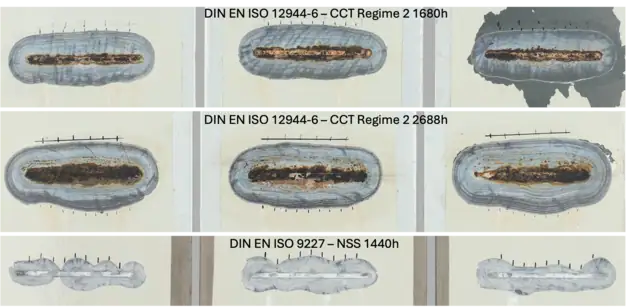
Following the test, further test procedures are carried out:
- Coating thickness measurement – ISO 2178
- Cross-hatch test ISO 2409
- Adhesion test in accordance with ISO 4624
Evaluation method:
- Bubble level ISO 4628-2
- Degree of rust ISO 4628-3
- Crack severity ISO 4629-4
- Degree of flaking – ISO 4628-5
- Corrosion on the Ritz ISO 4628-8
Our customers then receive a detailed report setting out the results and stating whether the requirements of DIN EN ISO 12944 for the intended area of application have been met.
Implemented by our independent inspection and certification body
IFO Institut für Oberflächentechnik GmbH offers Certifications in accordance with DIN EN ISO 12944 . Our experienced inspectors possess extensive specialist knowledge and expertise in assessing the quality of coatings. They carry out on-site inspections to ensure that the corrosion protection systems have been applied in accordance with the relevant standards and specifications, and that the laboratory requirements for the various corrosivity classes (C1–CX) are met. The IFO Certification Body ensures the independent assessment of the certification through accreditation in accordance with ISO 17065 and certifies this with a certificate from the highest accreditation authority, DakkS in Berlin.
The Certification programme for paint manufacturers The IFO Certification Body offers customers the benefit of obtaining high-quality paints in accordance with DIN EN ISO 12944. This certification guarantees the quality assurance of the coatings, meaning that customers can rely on their reliability and compliance to ensure effective corrosion protection for their steel structures.
Ensure your products have a long service life and are of high quality: optimise your corrosion protection measures – we are your trusted partner for testing and certification in accordance with DIN EN 12944. Get a free consultation now at 07171 / 10407-0
Determination of effective corrosion protection and overview of the service life in accordance with DIN EN ISO 12944
Corrosivity category: The correct assessment for effective corrosion protection
DIN EN ISO 12944 defines Corrosivity categories, which reflect the environmental conditions to which steel structures are exposed. This classification enables the targeted selection of coating systems to provide the appropriate corrosion protection. The classes range from C1 to C5 and cover a variety of environments, from low to high corrosivity.
| Corrosivity category | Description |
|---|---|
| C1 | Very low corrosiveness (dry indoor environments) |
| C2 | Low corrosiveness (damp indoor environments) |
| C3 | Moderate corrosiveness (urban and industrial environments) |
| C4 | High corrosiveness (industrial environments with high humidity and aggressive conditions) |
| C5 | Very high corrosiveness (harsh atmosphere, such as in coastal regions) |
| CX | Exceptional corrosion exposure: Environments subject to aggressive conditions, e.g. offshore applications |
DIN EN ISO 12944 uses corrosivity categories to describe environments for steel structures in detail. The definition of the corrosivity categories is derived from ISO 9223, in which the corrosivity categories are defined according to corrosion removal rates on uncoated test specimens or the composition of the atmosphere (e.g. chloride content or SO₂ content). They facilitate the assessment of corrosion exposure and the selection of suitable protective systems. This supports the precise selection of corrosion protection measures in accordance with the specific environmental conditions. Not every application requires the best corrosion protection system.
Duration of corrosion protection: Effective protection for long-term durability in accordance with DIN EN ISO 12944
DIN EN ISO 12944 provides important guidelines for the corrosion protection of steel structures and also defines the duration of protection. These specifications are of great importance in ensuring the effectiveness, durability and, ultimately, the service life of corrosion protection systems, so that they meet the requirements in various environments. The standard distinguishes between four different time intervals:
| Term of protection | Time interval |
|---|---|
| L (from ‘low’) – low | <7 years |
| M (English: medium) – medium | 7 ≥ x < 15 years |
| H (English: high) – high | 15 ≥ x ≤ 25 years |
| VH (from ‘very high’) – very high | ≥ 25 years |
The service life should not be understood as a warranty period, but rather as a planning parameter indicating the point from which maintenance measures must be planned.
We are here to assist you with any specific enquiries regarding corrosion testing – we are your reliable partner for tests in accordance with DIN EN ISO 12944. Get some no-obligation advice now at 07171 / 10407-0