
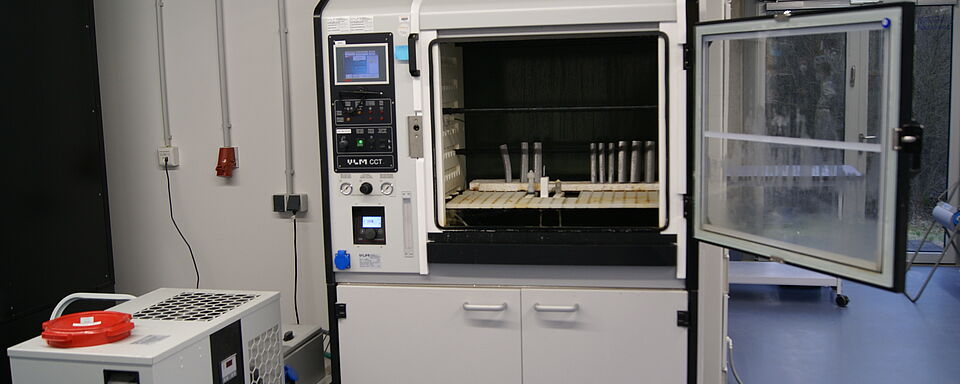
STANDARD-COMPLIANT CORROSION TESTING USING THE CCT METHOD
Corrosion remains one of the most critical challenges for metal components across industrial applications. Whether in the automotive industry, construction, agricultural machinery, aerospace, or mechanical engineering – reliable assessment of corrosion behavior is essential for ensuring the safety, durability, and functionality of components.
The cyclic corrosion test (CCT) is a proven method for the accelerated simulation of corrosion processes. Unlike conventional salt spray tests, CCT combines corrosive atmospheres with alternating climate conditions, creating far more realistic stress scenarios for materials and coatings.
With our high-performance, CCT-compatible corrosion chamber, we perform tests in compliance with leading standards such as VDA 621-415, DIN EN ISO 119971-1 (Cyclce B), DIN EN ISO 60068-2-52, VW PV 1209, VW PV 1210, and many other OEM specifications – in a reliable and reproducible way that is individually tailored to your needs.
What is a CCT test?
The Cyclic Corrosion Test (CCT) is a standardized corrosion test that exposes samples to repeated cycles of salt spray, condensation, drying, heating, and cooling. The aim is to simulate realistic corrosion – like that encountered in road traffic, offshore applications, or industrial atmospheres.
By combining chemical and climate stress factors, the CCT method offers an accurate representation of real-world exposure and is therefore widely used for OEM approvals. Manufacturers rely on CCT for evaluating and qualifying corrosion protection systems, coatings, and fasteners.

CCT TEST CONDITIONS: ALTERNATING SALT, TEMPERATURE, AND HUMIDITY
In contrast to traditional salt spray testing (DIN EN ISO 9227), CCT replicates natural conditions through cyclical phase changes, including:
- salt spray phases
- high humidity phases
- drying at elevated temperatures
- cooling or cold phases
- rest or store phases
Depending on the applicable standard, these sequences can last from a few hours to several days per cycle – and are often run over hundreds of hours to reflect long-term corrosion exposure. The sequence enables combined corrosion exposure, as occurs in the real-world use of vehicles parts or metal structures.

Typical Applications: Automotive and Industrial Components
CCT is ideal for evaluating:
- vehicle parts made of galvanized or coated steel/aluminium
- coated fasteners (screws, nuts, bolts)
- coating systems on metallic substrates (e.g., powder coatings, cathodic dip coating, duplex systems)
- assemblies with cathodic corrosion protection
- OEM-specified protective coatings
- painted plastic parts
- multi-material assemblies
All components that are exposed to stress under the specified conditions during subsequent use.
CCT is especially important for OEM approvals, where combined corrosion exposure must be proven under defined factory standards. Only components that meets these stringent requirements are approved for serious production.
Our Test Facilities: Advanced CCT Chambers for Flexible Scenarios
Our testing laboratory is equipped with state-of-the-art climate chambers for cyclic corrosion testing, offering:
- fully automated salt spray cycles
- precisely controlled temperature and humidity profiles
- customizable test programs
- testing of components up to 2 meters in length
Our technology also allows for combined tests, in which CCT can be combined with additional UV exposure or mechanical stress, for example. We will gladly help you define the right test setup for your application.
Testing According to International Standards and OEM Specifications
We conduct cyclic corrosion testing in line with all current international standards and manufacturer-specific requirements. These include, among others:
Testing standards:
- DIN EN ISO 11997-1 (Cycle B)
- DIN EN ISO 12944
- DIN EN ISO 60068-2-52
- VDA 621-415
- VW PV 1209
- VW PV 1210
- …and more
OEM and factory standards:
- BMW: GS 90011, GS 94007
- Volkswagen: TL 182, TL 227, TL 244, TL 256, TL 260
- Mercedes-Benz/Daimler: DBL 7382, DBL 7390, DBL 7391, MBN 10494-6
- Caterpillar: 1E2732
- AAMA: 2603, 2604, 2605
- …and more
With extensive experience in OEM-specific testing requirements, we are your trusted partner for corrosion testing in the approval process.
Evaluation Method: From Visual Inspection to Advanced Analysis
After testing, a comprehensive evaluation of the test samples is carried out. Depending on the material and standard, the following methods are used:
- visual inspection (e.g., blistering, rust grade, adhesion)
- weight loss analysis
- coating thickness measurement
- microscopic examinations

Your Service Provider for Cyclic Corrosion Testing – Expertise for Industry and Automotive
As an experienced B2B service provider for corrosion and climate testing, we support companies in the automotive, engineering, and coating industries.
With our range of standard-compliant cyclic corrosion tests, individual testing advise, and flexible testing capacities, we offer you everything from a single source:
- standard-compliant corrosion testing under climate load
- cyclic corrosion testing for OEM-approvals and series releases
- expert support with test planning, execution, and documentation

Contact us for a no-obligation consultation
We are happy to help you define the right test method and provide dependable support for your quality assurance.
Request a free consultation today: +49 7171 / 10407-0
Area of competence
Testing standards
- DIN EN ISO 11997-1
- DIN EN ISO 12944
- DIN EN ISO 60068-2-52
- PV 1209
- PV 1210
- VDA 621-415
Factory standards
This test is part of the following manufacturer and requirement standards:
Show standardsAAMA
AAMA 2603 AAMA 2604 AAMA 2605BMW
GS 90011 GS 94007Bundeswehr
TL 8010-0001 TL 8010-0002Caterpillar
1E2732Mercedes / Daimler
DBL 7382 DBL 7390 DBL 7391 MBN 10494-6NATO
STANAG 4360 / AEP-64Volkswagen
TL 182 TL 227 TL 244 TL 256 TL 260Your contacts
M. Sc.
Teamleiter Korrosionsprüfung

Stellv. Teamleitung Materialprüfung