
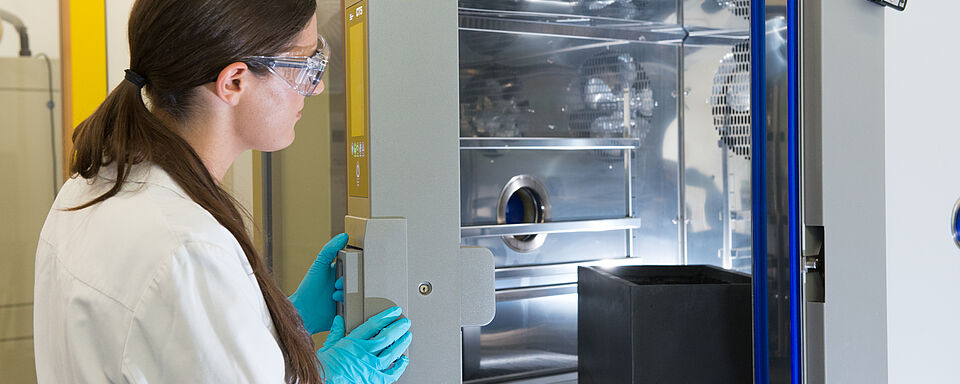
Reliable Climate Change Testing with the ACT test: Realistic Aging Simulation in accordance with OEM standards
ASSESSING CLIMATE RESISTANCE IN METAL AND COMPOSITE COMPONENTS
The Alternating Climate Test is a proven method for realistically simulating alternating climate loads and is used for accelerated evaluation of the aging behavior of materials and components. In many industries – especially automotive, construction, aerospace, and electrical engineering – the climatic durability of materials and surfaces is a decisive quality factor.
By replicating cyclical temperature and humidity changes, the ACT test enables early detection of material changes and potential damage. The combination of elevated temperatures, humidity, and optional frost and dry phases creates conditions that mirror years of real-world environmental exposure – in a significantly shorter time.
Our advanced ACT climate chamber allows us to perform demanding, standard-compliant tests in accordance with a wide range of OEM specifications. Backed by years of testing expertise, we support you from test planning to results evaluation.

Contact us for a no-obligation consultation on your climate change test.
We are happy to help you select suitable testing methods and provide you with reliable support for your quality control.
Get a no-obligation consultation now +49 7171 / 10407-0
Application Areas and Objectives of Alternating Climate Tests
The alternating climate test is designed to assess the lomg-term performance of materials and components under cyclic environmental stress. It examines both mechanical integrity and visual changes such as cracking, discoloration, or delamination. Common use cases include:
- painted, coated, or galvanized surfaces
- exterior automotive trim elements
- fasteners and metallic materials
- painted plastic parts (e.g., in the automotive sector)
Thanks to the targeted combination of wet-dry cycles and thermal variation, the ACT enables accelerated environmental aging test – without the use of corrosive media, as is the case with the cyclic corrosion test. It is therefore particularly suitable for pre-evaluating climate resistance prior to market launch or for quality assurance in serial components.

Standards-Based Testing According to OEM Specifications
We perform ACT tests in compliance with a wide range of current OEM and industry standards, including:
- BWM PR 303.5
- DBL 5416 (Mercedes-Benz)
- PTL 8140 (Porsche)
- PV 1200 / PV 2005-A (Volkswagen)
In addition, we meet requirements from high-level specifications such as:
- AAMA 611
- DBL 7381
- PTL 5536, PTL 5538
- TL 211, TL 226, TL 52451
These standards define test profiles with specific temperature-humidity curves, cycle counts, and evaluation criteria – such as gloss level, color tone, or dimensional stability.
Our flexible test equipment ensures precise implementation of both customer-specific and standardized test parameters.
Technical Implementation in our Alternating Climate Test Chambers
Our testing facility meets the highest technical standards for accelerated environmental simulation:
- temperature Range: -40 °C to +60 °C
- humidity range: 10 % to 98 % RH
- automatic control of temperature, humidity, and drying cycles
- testing of components up to 2 meters in length
- high-precision cycle control and narrow tolerance rages
- immediate evaluation possible after test completion

Why choose IFO for ACT Testing?
- testing to OEM specifications – tailored to your customers' exact requirements
- accredited procedures – results usable for OEM approval
- flexible test design – special profiles also possible
- fast turnaround – through efficient lab coordination
- detailed evaluation – including photo documentation and reporting
- expert consultation – with in-depth knowledge of materials and standards
As a specialized laboratory service provider, we offer not only testing services, but also expertise. We advise you on the selection of standards, testing strategies, and suitable evaluation methods.
Evaluation Methods Following the Alternating Climate Test
After completing the climate change test, we evaluate your samples based on the applicable standards. Typical methods include:
- visual inspection for cracking, color change, or delamination
- gloss measurement before/after testing (e.g., DIN 67530)
- evaluation according to factory standards and ISO standards
- full documentation including before-and-after photos
- functional testing of component assemblies (as required)

ACT vs. CCT – What are the Differences?
The Alternating Climate Test focuses on climate-related stresses (temperature, humidity) without introducing corrosive media. In contrast, the Cyclic Corrosion Test adds aggressive substances like salt spray, SO2, or acid rain.
The Alternating Climate Test is therefore particularly suitable for:
- weather simulation without corrosive agents
- testing for material fatigue due to climate change
Both methods can be combined, depending on your testing objectives.
Your Partner for Reliable Climate Change Testing
With state-of-the-art equipment and cross-industry experience, we support your efforts to ensure product quality and environmental durability. Rely on our modern climate chambers and standards-compliant proceses for meaningful, reproducible results.
Request your feee consultation now: +49 07171 / 10407-0
Area of competence
Testing standards
- BMW PR 303.5
- DBL 5416
- PTL 8140
- PV 1200
- PV 2005-A
Factory standards
This test is part of the following manufacturer and requirement standards:
AAMA
AAMA 611Mercedes / Daimler
DBL 7381Porsche
PTL 5536 PTL 5538Volkswagen
TL 211 TL 226 TL 52451Your contacts
M. Sc.
Teamleiter Korrosionsprüfung

Stellv. Teamleitung Materialprüfung